Wednesday, October 26, 2011

Half of Manitobans Not Saving Their Money

Half of Manitobans Not Saving Their Money
Canadians are not saving enough money and don’t feel optimistic about the future, that’s according to a new study out today. The survey conducted by Royal Bank of Canada says 57 percent of Canadians don’t have savings for a rainy day fund, and those who do, tend to use the funds to pay for every day expenses. “It speaks to the importance of having a plan for a rainy day, for retirement and for some of the unfortunate unforseens in life such as disability.” says financial consultant Leslie Hamilton with Investors Group. The study also found nearly half of people in the prairies aren’t saving for a rainy day fund with 27 per cent saying they dip into their savings for every day spending or emergency. 27 year old Jason Andrews says he’s struggling to save money these days. “It still just seems like you could never really get ahead, it’s tough to save,” said Andrews. Andrews who recently bought Winnipeg Jets season tickets says he now plans on cutting back on expenses he doesn’t really need. “I’d say anything on my car would be too much, buying a TV big screen just anything that I would have to use my credit card,” said Andrews.

Some say inflation is also hurting consumers but the survey also found Manitobans are also optimistic about the future and plan on reducing their debt this year. “Consumers here in Saskatchewan and Manitoba are concentrating on very positive ways to help mange their debts,” said Rob Johnston, regional president for RBC. University of Winnipeg student Brittany Thiessen isn’t hopeful she’ll be able to save until she pays off her debt. “Well a lot of my money goes towards paying tuition and books are also very expensive and then once you pay for that you really don’t’ have much left over,” said Thiessen.


Most British Columbians Put Savings on Hold to Pay Down Expenses
Nearly six in 10 British Columbians – 58 per cent — are not saving for a rainy-day fund, while 32 per cent are using savings for daily expenses or emergencies, according to the October RBC Canadian Consumer Outlook Index released Wednesday. While the B.C. numbers are slightly higher than the national average — 57 per cent and 30 per cent, respectively — British Columbians also intend to take action in managing their finances in the coming year, with 28 per cent planning to reduce debt, 30 per cent planning to spend less, 19 per cent hoping to save or invest more and 24 per cent planning to do all three. The report found that 58 per cent of B.C. consumers have delayed making a major purchase such as a car, household appliances or vacation because of the economy.

Monday, August 29, 2011

Canadian Delusions of Debt

Delusions of Debt Freedom Abound
Canadians have an unrealistic vision of their financial futures. A new CIBC poll conducted by Harris-Decima found most Canadians think they’ll be debt-free in another decade or so when, in fact, that isn’t likely to happen.One key finding is that across all age groups (18 to 64), Canadians, on average, believe they will be debt-free 10 to 15 years from their current age. However, the CIBC report notes that many Canadians still hold debt beyond the average age identified by each age group.For example, Canadians 25 to 34 believe they will be debt-free, on average, by age 44. Yet among today’s 45 to 54-year-olds, only 18 per cent report being debt free, suggesting today’s 25 to 34-year-olds are in for a bit of a rude shock. Overall, the poll found Canadians expect they will be debt-free by age 55, but in fact only 35 per cent of today’s 55 to 64-year-olds have actually reached credit nirvana.

Saturday, July 30, 2011

Record Household Debt Could Be Canada's Undoing

Record Household Debt Could Be Canada's Undoing
The very thing that lifted the economy from the depths of the recession — Canadians’ passion for owning a home — could also be its undoing, warns the chief economist for RBC Global Asset Management. Central to Eric Lascelles’ concern is that the availability of cheap credit has driven household debt levels to record highs and soon-to-be-rising interest rates will bear a “palpable” impact on individuals as well as the broader economy.“The very source of Canada’s relative success during the worst of the credit crunch — a banking sector that kept on lending and households that kept on buying — could yet spell its undoing if newly enlarged household debt loads prove too onerous to bear,” Mr. Lascelles says in a report issued Tuesday.

Friday, July 15, 2011

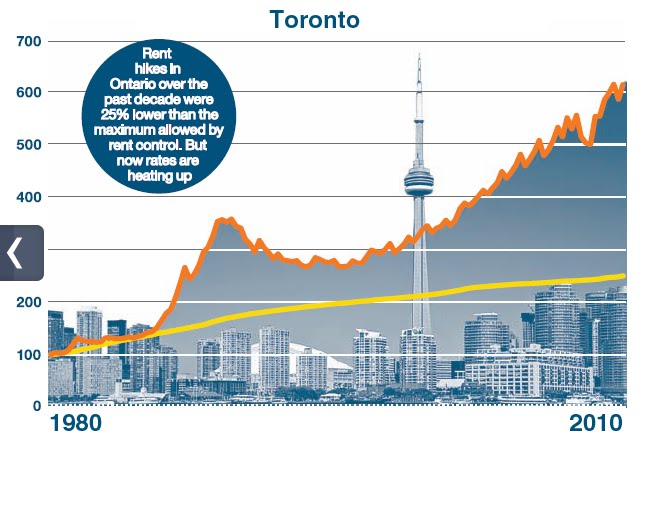
Canada House Prices vs Rent 1980-2010


Canada's Income Gap Widens

Canada's Income Gap Widens
The income gap between rich and poor in Canada widened in the period from 1993 to 2009, the Conference Board of Canada reported Wednesday. The richest Canadians increased their share of total national income while the poor and those with middle incomes saw their portions shrink, according to the board's analysis, entitled "How Canada Performs." Incomes of the poor increased marginally in the period, it said, but the gap between rich and poor widened. The average income of the poorest Canadians rose from $12,400 in 1976 to $14,500 in 2009....The average income in 1976 was $51,100. By 2009, it had increased by 17 per cent to $59,700, even after adjusting for inflation.But using the measure of median income, which divides the sample into two equal parts and better reflects how the majority of people are doing, the growth was only 5.5 per cent.

Thursday, July 14, 2011

Wednesday, July 13, 2011

TD Warns, House Prices To Fall

Home Prices To Fall, TD Warns
The average price of a resale home in Canada will fall by more than 10 per cent over the next couple of years, an analysis by TD Economics predicted Wednesday. Calling it a "moderate correction," the report's authors also say sales will decline by more than 15 per cent over the same period."A combination of more subdued job and household income growth, rising interest rates, the recent tightening in borrowing rules for insured mortgages and fewer first time home buyers are expected to be the chief culprits behind the slowdown," the report said. TD economists profiled 12 urban markets across the country. They highlighted Vancouver and Toronto — currently the two most expensive housing markets in Canada — as the cities most vulnerable to a larger-than-average decline, "reflecting in part their exposure to the condominium segment, which appears particularly ripe for a correction."

TD Report

Wednesday, July 6, 2011

Canadian Debt Hits Record High

Canada Household Debt Rises
Canadian household debt hit a fresh high as consumers continued to borrow at a faster rate than their wages grew—heightening a key vulnerability of the country's otherwise healthy-looking economy. Economists, as well as the nation's central bank, have increasingly warned against rising household debt, as Canadians borrow at a healthier clip than even their typically more profligate American neighbors. U.S. borrowers have recently reined in their own debt after a deep recession and housing-market bust there. Canadians, meanwhile, have binged on debt, encouraged by mostly rising home prices, low interest rates and economic-growth prospects that are among the best in the Group of Seven. The quarterly ratio of household credit debt—incorporating mortgages and consumer loans—to disposable income hit 147.3% in the January-to-March period, up from 146.2% in the preceding quarter, according to Statistics Canada data released Monday. That's the highest level since the agency began keeping these figures, dating back to 1990. It is also up sharply from just four years ago, when the figure was 127%.

Canada's Bubble About to Burst
The London-based research firm Capital Economics Ltd. has added a new spark to Canada's housing debate with its assessment that the country's real estate market is a bubble that is about to pop. The boom in Canadian real estate has "resulted in the largest rises in house prices ever seen in Canada," the firm says. "And the trigger of an increase in the Bank of Canada's trendsetting interest rates could result in a 25-per-cent drop in property values," it adds. The organization released the research earlier this year in a report for its subscribers, and it received new currency from Bank of Canada Governor Mark Carney's statement, given earlier this week, warning Canadians that they should expect real estate prices to begin to moderate. However, while Carney did not use the word bubble, Capital markets wasn't shy about doing so.

Wednesday, June 15, 2011

Household Debt Hits Record $1.5-trillion

Household Debt Hits Record $1.5-trillion
Household debt has hit a troubling $1.5-trillion, sparking new fears that the heavy burden on Canadian consumers could hurt the economy, particularly as fiscal stimulus fades.The figure, from a report Tuesday by the Certified General Accountants Association of Canada, means that if household debt were distributed evenly across all Canadians, a two-child household would owe an estimated $176,461, including mortgage costs...About 27 per cent of working Canadians aren’t saving, while single-parent families, retirees and households with an income of $50,000 and under are in particularly dire straits. Single parents were the only family category listed in the report where debt climbs with age, and one-third of retired households are burdened by an average debt of $60,000. Households with an income of less than $50,000 are “six times more likely to be financially vulnerable in terms of their debt-service ratio,” the study said.

Carney Warns On Housing Markets

Carney Warns On Housing Markets
Mark Carney is issuing a sharp warning that the housing market may be overheating, as his ultra-low interest rates, combined with too much optimism on the part of buyers, fuels prices in the country’s hottest markets. Even as growth in mortgage credit has started to slow and prices are expected to moderate, investment in residential properties nationwide is now near peak levels, Mr. Carney said in a speech to the Vancouver Board of Trade. Without using the word “bubble” to describe a housing market where prices are now 13 per cent above their pre-recession peaks, and without saying the Bank of Canada will take specific measures to tame the sector, Mr. Carney left little doubt that he is concerned.

The risk is that expectations become extrapolative, prompting the classic market emotions of fear and greed – greed among speculators and investors, and fear among households that getting a foot on the property ladder is a now-or-never proposition,” he said. Tellingly, Mr. Carney noted that in Vancouver, the country’s priciest market, as in other “globalized” markets like Sydney and Hong Kong, Asian wealth is coming in as investors diversify and look for hard assets, fuelling valuations that in some cases are “extreme.”...Indeed, while the mortgage market in Canada is more conservative than in the United States, where the subprime lending collapse triggered the 2008 financial crisis and Great Recession, Mr. Carney said real estate loans now make up more than 40 per cent of Canadian banks’ assets, compared with 30 per cent a decade ago, a situation he called “unprecedented exposure.”

Friday, June 10, 2011

Retire At 80?

Many Of Us Won’t Be Able To Retire...
We all think it’s a panacea. If you don’t have enough money saved for retirement, you’ve got a few ways to close the gap between what you have and what you need in your nest egg: Save more, invest more aggressively, and/or work longer. Well, it turns out that working longer is indeed an option, according to the Employee Benefit Research Institute latest study. The only problem is that the latest research shows that you’ll have to work much longer than you anticipated. In fact, many Americans will have to keep on working well into their 70s and 80s to afford retirement, according to the study, titled “The Impact of Deferring Retirement Age on Retirement Income Adequacy.”

What’s more, it’s even worse for low-income workers, according Jack VanDerhei, one of the co-authors of the study. Those who earned (on average over the course of their careers) less than $11,700 per year, the lowest income quartile, would need to defer retirement till age 84 before 90% of those households would have just a 50% chance of affording retirement. Those who earned between $11,700 and $31,200 will need to work till age 76 to have a 50% chance of covering basic expenses in retirement. Those who earned between $31,200 and $72,500 will need to work to age 72 to have a 50% chance and those who earned more than $72,500, those in the highest income quartile, catch a break; they get stop working at age 65 to have a 50/50 chance of funding their retirement.

Wednesday, June 8, 2011

Asian Real Estate Influx

Vancouver Primed For Housing Correction: BMO

Vancouver Primed For Housing Correction
Vancouver’s housing market looks primed for a correction, according to a report from BMO Nesbitt Burns, with the average house now costing “an astounding” 11.2 times a family’s average income -- more than double the national average. But senior economist Sal Guatieri said there’s hope that any drop in prices could be less severe than previous corrections -- “if interest rates stay low and wealthy immigrants continue to pour into the city, prices could stabilize sooner than in past downturns.”The city has seen four corrections in the last 30 years -- in 1981-82 (-30 per cent), 1990-91 (-14 per cent), 1995-96 (-20 per cent) and 2008-09 (21 per cent). Even so, the average house has gained 21 per cent in the last year, or a whopping 188 per cent in the last decade and was worth $815,000 at the end of April.

Government Intervention Needed In Canadian Real Estate

Is Government Intervention Needed To Stop The Rise In Canadian House Prices?
High housing prices across the country have some wondering if government intervention is needed to make owning a house a realistic goal for the average Canadian family. A BMO Capital Markets report, released Tuesday, suggests that while a real estate market correction is imminent, low interest rates, and levels of immigration and foreign investment have buoyed home prices to historic heights when compared to family incomes. "At 5.1-times median family income, housing is by no means cheap, costing an extra two years of gross income compared with 2001, when the boom began and valuations were closer to historic norms," noted the report. In Vancouver, Canada's most expensive city, the average-priced home is now an astounding 11.2 times family income, more than double the decade earlier ratio and the current national figure. "Riding a wave of wealthy immigrants, Vancouver's house prices have nearly tripled in the past decade, spiralling beyond the reach of most first time buyers or non-lottery winners," the report stated.

Monday, June 6, 2011

Madani: Canadian Real Estate Overvalued

Building Permits Drop
But Madani said he does see trouble down the road — in late 2011 and 2012 — because Canadian home prices are substantially overvalued. He predicts as much as a 25 per cent drop in home prices in the coming years. As soon as prices drop, he said, construction activity follows because builders want to avoid a glut of unoccupied homes on the market. "We're of the opinion that we've simply built too many homes," Madani said.The housing market has been slowing in many parts of Canada and in some cities. An overbuilt condominium sector — especially in big cities like Toronto and Vancouver — has also started to weigh down the market.

Wednesday, June 1, 2011

Canadian Consumer Debt At 26,000

Canada's Personal Debt Rises
Canadians rang up five per cent more in personal debt in the first three months of 2011 compared with 2010, according to a report released Wednesday. TransUnion, a Chicago-based credit specialist, said the average Canadian had almost $26,000 on his or her credit card, bank lines of credit and other borrowing vehicles — excluding mortgages — during the January-to-March period. That amount represented a jump of more than $1,200 compared to the same three months one year earlier.

Tuesday, May 17, 2011

Home Prices Continue Climb

Home Prices Continue Climb

Canadian home prices continued their upward march in April, driven by strong investor demand in Vancouver, as cracks in the Toronto condominium market may be starting to appear.The Canadian Real Estate Association said yesterday the average price of a home sold in April in Canada was $372,544, up 8% from a year ago. It was the third straight month that the average price rose 8% on a yea-over-year basis but the Ottawa-based group cautioned that the figure was skewed due to “surging multimillion-dollar property sales in selected areas of Greater Vancouver.”...orries about the sustainability of the housing market could be stoked by a report from Urbanation Inc., which monitors the Toronto condominium market. The group says more than 50% of condominiums purchased in the last year were by buyers who do not intend to occupy their units and plan to rent in many instances. Condominium rents in Toronto in the first quarter of 2011 were $2.11 per square foot compared to $2.09 a year earlier, a 0.8% increase. Condominiums being registered now and ready to be occupied are priced for sale at $450 per square foot range while newer units are going for $550 per square foot.

Saturday, April 23, 2011

Canadians Struggling To Save

Canadians Struggling To Save
Many Canadians are finding themselves caught between the struggle to save money and repay their debts, says a survey from TD Bank. And with interest rates expected to rise this summer, clearing debts probably won't get any easier. In the report, 38 per cent of Canadians surveyed said they had no savings at all. "I think it's worrisome," said Carrie Russell, senior vice-president of retail banking at TD Canada Trust (TSX:TD). "The reality is that we are all going to come into unexpected expenses from time to time, be it a car or health or a job loss and this can really derail you and your family if you have no cushion behind you," Russell said from Toronto. Russell said the major factor preventing Canadians from saving is that they are using disposable income to pay down debt, whether it be credit cards, car loans or mortgages. She recommends a cushion of three to six months of income saved to get through unexpected financial shocks. One-third of Canadians who responded to the recent online survey also said they didn't have enough money to cover living expenses like rent or food bills. The survey found that 54 per cent of the 1,003 people who took part in the survey said it was a real struggle or impossible to save.

Wednesday, April 13, 2011

Winnipeg House Prices Surpass National Average

Two-storey Digs Ride Price Rocket
THERE'S a new filly leading the local house-prices derby -- the standard two-storey home, according the latest survey by Royal LePage. The real estate firm said Tuesday the average selling price of a two-storey home in Winnipeg increased at one of the fastest paces in Canada during the first quarter this year, jumping by 7.1 per cent to $297,125 from $277,375 a year earlier. The only city among the 16 surveyed with a bigger year-over-year gain was Vancouver, at 9.7 per cent. The surge in two-storey house prices is a change from previous quarters, where bungalows led the charge. But even so, the average price for a bungalow climbed 3.8 per cent to $269,250 from $259,313, and the price of a standard condo rose by four per cent to an average $167,429 from $161,000...Winnipeg also had the third largest year-over-year gain in prices, at 4.6 per cent, eclipsing the national average hike of 2.1 per cent.

Village on False Creek to Lose $250 MM